
Kentucky Arrest Logs Differ
The label "Weekly Arrest Log" sounds official. It promises no statewide weekly publication. In Kentucky, an arrest log can mean a jail booking list, an incident blotter, a Kentucky State Police release, or a newsroom story. Each type records something different. A booking log tracks jail processing. An incident blotter can include calls, citations, warrants, and events that never involved a booking. A news release picks only the items an agency wants the public to see. A multi-day search helps when a custody page changes, a short booking view rolls off, or an agency posts after review, so read the publisher, date, and record type before treating an entry as a booking.
Use the record that fits the question. A county jail confirms local custody, a police blotter reports selected activity, and the court record shows what happened later in the case.
Kentucky County Booking Log Windows
Kentucky counties archive bookings differently. Jefferson and LMDC have long offered a booking log or date-range view. Fayette's public page is a 48-hour list. Christian and Letcher expose short booking controls, though those settings do not make older inmates searchable.
| Official source | What its public view does | Archive limit |
|---|---|---|
| Jefferson County / LMDC | Louisville Corrections has historically offered current inmate and booking-log or date-range access. | The operational portal can change or be blocked; confirm availability with the agency. |
| Fayette County / Lexington | The official Recently Booked list states a 48-hour window. | That short window is not a deep public archive. |
| Christian and Letcher | BlueHorse screens expose a 24-hour booking control; details may include an image. | The control does not imply a searchable historical roster; Letcher’s captured historical setting was disabled. |
For Jefferson bookings, start with the official Louisville Corrections search. Fayette's Recently Booked page covers only a short period. Letcher's jail site routes to a vendor roster. Portals change, so treat each as a starting point. The Kentucky County Directory links to every local system.
Note: A county screen's time filter is a local setting, not a Kentucky-wide archive promise.
Kentucky State Police Multi-Day Releases
KSP’s searchable News archive is the official multi-day statewide activity source, but it contains selected releases rather than every booking. Its entries can reflect investigations, traffic enforcement, DUI or checkpoint results, fugitive notices, and other public-safety items. A release may follow the event after review; silence in the archive does not mean no arrest occurred.
Search the KSP News archive by topic, post, or date range, then compare the release date with the event described. The archive is selected agency reporting, not a live booking roster or a complete weekly log.
Reading a Kentucky Arrest Entry
Kentucky has no uniform blotter field list. Every format labels things its own way. A booking log, an incident report, and a news release keep different details. KSP's archive shows a release date, place or post, narrative, and topic labels. A booking list is tied to jail intake. A county blotter may instead focus on the incident type or reported activity.
| Entry detail | How to read it |
|---|---|
| Release or publication date | When the agency or newsroom published the item; it may be later than the event. |
| Event date and location | Where an incident or enforcement action took place, if the source provides it. |
| Agency, post, or department | Identifies who issued the release or handled the reported event. |
| Narrative or topic label | Summarizes selected information; it is not a complete case file or booking history. |
| Booking or custody status | Only a jail record can confirm the status it currently reports; a news story may not be updated. |
A blotter can mix arrests with citations, warrants, crashes, or calls. An arrest entry does not show where a person was booked. When custody status matters, ask the holding jail directly.
Kentucky Weekend and Holiday Timing
Weekend and holiday posting in Kentucky rarely matches a live jail view. Agencies often publish after review. Newsrooms may wait for an editor or an agency account. The publication date can lag the event. Kentucky sources share no common weekend schedule. A batch of entries appearing together may simply mean delayed updates rather than a statewide rise in bookings, so compare event date, publication date, and source type.
Weekend and holiday lag: a county or newsroom may post after the event. Updates may resume on a later business day. An empty page during a holiday is not proof that no arrests occurred.
For fresh custody, the Daily Arrest Report covers Kentucky's short-window county systems. The Weekly Arrest Log handles broader blotters and archives.
Note: Several entries posted together may reflect a delayed update rather than a statewide change in arrest activity.
Kentucky News Arrest Blotters
Kentucky newsrooms publish selected arrest, indictment, warrant, and police-release stories. Some include an agency-supplied or booking photo. Coverage varies by region and editorial judgment. These stories can help locate a published account, but none is a complete statewide booking roster or an official custody source.
| News outlet | Coverage path | Limit to keep in mind |
|---|---|---|
| WKYT | Crime reporting, including selected agency and court stories. | Use its free newsroom correction route for factual errors; no automatic photo opt-out was verified. |
| WDRB | Crime Reports covering the outlet’s regional news area. | A story is selected reporting, not a jail’s live list; request a correction with the story URL. |
| LEX18 | Crime coverage and selected arrest or police-release stories. | Editorial review may update a resolved story, but it is not a guaranteed takedown. |
| WHAS11 | Crime coverage and selected police or court reports. | There is no verified automatic booking-photo removal promise. |
| WAVE 3 | Crime news from its regional coverage area. | Its newsroom correction route is an editorial review path, not a removal guarantee. |
| Kentucky.com / Lexington Herald-Leader | Local crime reporting and a separate Most Wanted archive. | A story may be corrected or updated without being removed when it remains accurate. |
Outlets offer free ways to raise a factual error or a legal update. Send the story URL through the current contact path. Attach court or agency proof. Editorial review is not an automatic removal policy, and an accurate story may remain after a case changes.
Request Older Kentucky Arrest Records
When a web log stops at a short window, request the existing record from its custodian. Know what you are asking for. A current jail roster, an old booking log, a court file, and a State Archives collection are different record sets. Name the county or agency first. Add the date range and record type. For an old case, a county Circuit Court Clerk or state archive may be a better route than the jail's live roster.
- Define the record. State whether you seek a booking entry, incident report, court case, historical register, or photograph. Include a name, county, agency, and date range if known.
- Contact the current custodian. For a recent booking log, ask the county jail or law-enforcement agency that created it. For court records, start with the county Circuit Court Clerk and the Kentucky Court of Justice records-request route.
- Check archive holdings. Use the Kentucky Department for Libraries and Archives (KDLA) request form when the record may be in its collections. Staff need the agency, record series, name, and time span to search.
- Plan for a research response. KDLA lists a nonrefundable $20 in-state fee or $25 out-of-state fee, possible added scan or copy costs, and an estimated four-to-six-week turnaround. This is archive research, not a same-day search.
The KDLA Records Requests page gives the archive request route and current fee notes. Confirm fees, tax, and delivery options there before sending materials.
The KDLA FAQ screenshot describes staff-assisted research requests and links to forms. The archive does not promise a statewide digitized booking-photo collection.
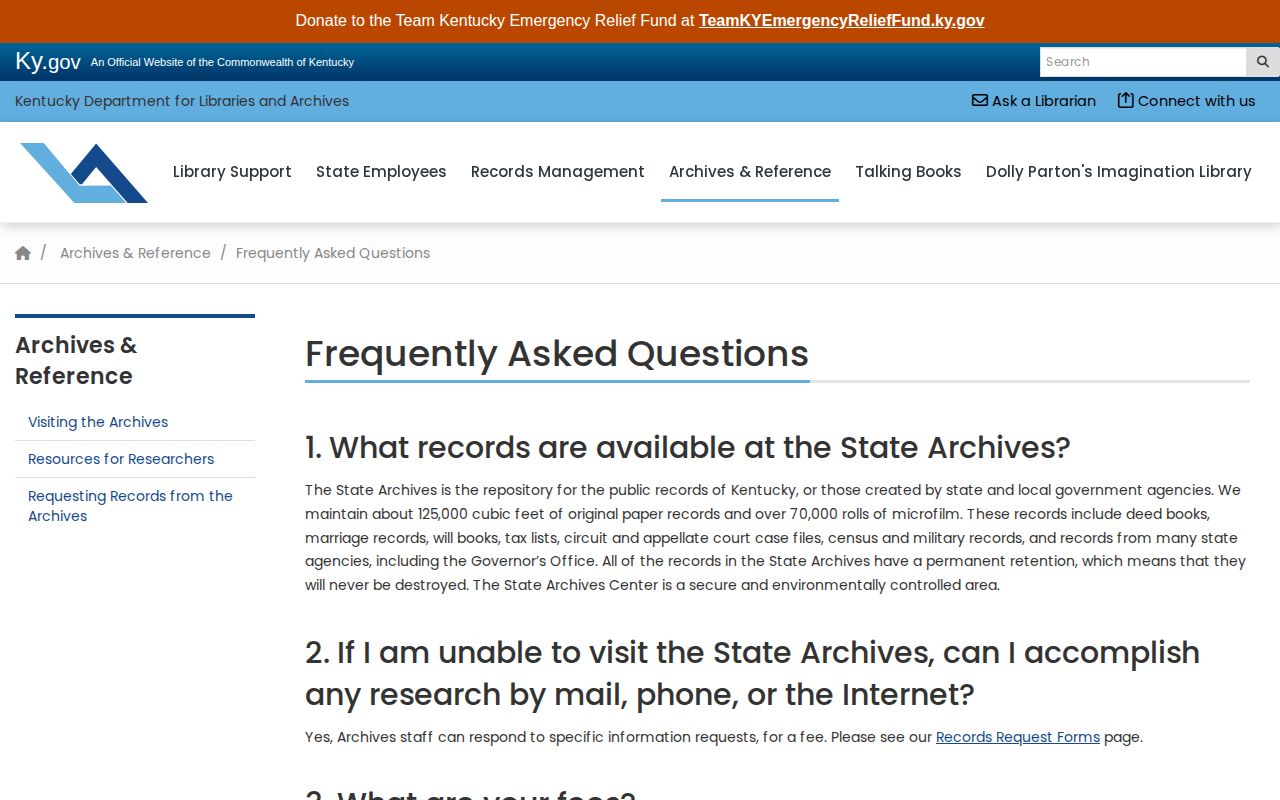
Court files live on a different shelf. The Kentucky Court of Justice records page lays out the clerk route, and older arrest-related court records may sit with the State Records Center or KDLA instead.
Kentucky Archive Depth Is Local
Kentucky sets no single statewide window for how long booking pages stay online. Jefferson kept a long historical booking log. Fayette shows only a short view, and Christian and Letcher both use brief BlueHorse settings. These are local choices, not state policy. A jail can pull entries from its roster. The records can still be kept under an approved schedule. The reverse happens too. A record series can hit its retention end without ever becoming a public online archive.
The Kentucky Department for Libraries and Archives publishes retention schedules for state government. Local governments often hold separate approved schedules of their own. Those rules govern what an agency keeps, not what you can search. A booking photo may exist on paper. It may still never appear in any online roster. Lexington-Fayette's local schedule lists booking-related photo and fingerprint series. That example stops at the county line.
The KDLA retention schedules show which records state agencies create. They also show how long agencies hold them. Treat them as a records-management reference. They are not an arrest roster, and they do not replace a public inmate search. Do not assume an older booking entry or image is still online. Check the listed series and its custodian.
Kentucky Mugshot Retention Is Separate
KSP's retention schedule names a "Mug Shot File" series, number 00042. It is kept for twenty years at the agency. Access limits and replacement or destruction rules apply. That schedule is a record-keeping rule. It is not proof of an online archive or a right to every booking photo.
Historical corrections registers held at KDLA tell a different story. They can list names or numbers, dates, crime, sentence, county, physical description, and discharge details. These are prison-era records rather than arrest-day photos. A shared name or county reference can send you down the wrong path.